Mica 7.7.8 makes optimized code shorter on both processors and brings it closer again to the code GCC -O2 writes. A branch that only chooses which value a variable takes becomes a conditional move, a loop counted down to zero branches on its decrement’s flags, a routine that calls nothing keeps no frame, and parameters, narrow values and constants reach their readers without copies of their own. No routine grows for a choice it converts.
The address of a field or an element behind a nil pointer stops the program
with nil_dereference where the address is taken, where it used to be handed
on and written through. And the export lists every instruction at its program
point. From the export, the Mica extension for VS Code draws a routine’s live
ranges, one value followed through the control flow, and the heap’s ownership
map.
A choice without a jump
{
    Choices - two functions whose branches only choose which value a variable takes.

    'Larger' keeps the larger of its two parameters, and 'Sign' answers one for a negative value and zero otherwise. Neither
    arm calculates, calls or writes memory, so at O1 and O2 each branch becomes a conditional move and the jump goes.
}
library Choices;

const
    Negative = 1;
    NotNegative = 0;

{ The larger of two values, kept in a local variable. }
exp function Larger(a : int64, b : int64) : int64;
var
    held : int64;
begin
    held := b;

    if a >= b then
        held := a;

    Larger := held;
end;

{ One for a negative value and zero for any other. }
exp function Sign(value : int64) : int64;
begin
    if value < 0 then
        Sign := Negative
    else
        Sign := NotNegative;
end;

begin
end.
mica --compile --optimize O2 --platform linux,arm64,utf-8 --source Choices.mica --build buildOn AArch64, build/Choices.s holds Larger and Sign as three instructions
each:
  cmp         x0, x1
  csel        x0, x0, x1, ge
  ret
cmp x0, #0
cset x0, lt
retThe same build for linux,amd64,utf-8 writes them for x86-64:
  mov         rax, rsi
  cmp         rdi, rax
  cmovge      rax, rdi
  ret
test rdi, rdi
mov rax, 1
mov r11, 0
cmovge rax, r11
ret7.7.7 wrote Larger in twelve instructions on AArch64 and fourteen on x86-64,
with a frame, a copy of each parameter and a jump around the store. Its
AArch64 version:
  stp         x29, x30, [sp, #-16]!
  mov         x29, sp
  sub         sp, sp, #16
  mov         x17, x0
  mov         x10, x1
  mov         x0, x10
  cmp         x17, x10
  b.lt        .Ll2.1
  mov         x0, x17
.Ll2.1:
  mov         sp, x29
  ldp         x29, x30, [sp], #16
  ret
At O1 and O2 a branch that only chooses which value a local variable takes is
one conditional move where the variable lives in a register, and a parameter
compared and answered on one of two arms is compared in the register it arrived
in, x0 and x1 on AArch64 and rdi on x86-64. A variable that lives in the
frame takes a plain store behind one jump. A choice between two literal values,
such as Sign’s two constants, converts where the if compares integers or
pointers and the variable is a 64-bit integer: a cset on AArch64, where an
arm that stores zero reads it from xzr.
A narrower variable, a condition read from a boolean variable or answered by a call, and an arm that calculates keep their jump, as does an arm that divides, converts, calls, reads through a pointer or writes memory another routine can see. So a checked build still traps only on the road that asked for it. A choice turned into a conditional move is never longer than its branch was. Leaving SSA shows the conditional store the compiler writes for such a branch before it becomes the move.
Loops counted down to zero
{
    Countdown - a loop that counts its rounds down to zero.

    'SquaresDown' adds the squares of the count, the count less one and so on down to one. Each round ends in the
    decrement of 'remaining', and at O2 the loop branches on that decrement's own flags.
}
library Countdown;

{ The sum of the squares from the count down to one. }
exp function SquaresDown(count : int64) : int64;
var
    remaining : int64;
    total : int64;
begin
    remaining := count;
    total := 0;

    while remaining > 0 do
    begin
        total := total + remaining * remaining;
        remaining := remaining - 1;
    end;

    SquaresDown := total;
end;

begin
end.
At O2 on AArch64 each round is a madd, the decrement as subs, and one
b.ne on the decrement’s flags:
  mov         x14, x0
  movz        x17, #0
  cmp         x14, #0
  b.le        .Ll2.3
.Ll2.2.rotated:
  madd        x17, x14, x14, x17
  subs        x14, x14, #1
  b.ne        .Ll2.2.rotated
.Ll2.3:
  mov         x0, x17
  ret
7.7.7 ended the round in sub x14, x14, #1, cmp x14, #0 and b.gt, comparing
the counter with zero again. On x86-64 the round now ends in sub r9, 1 and
jne, where 7.7.7 wrote sub r9, 1, test r9, r9 and jg. A counter stepped
up by one from a negative start does the same. At O1 and O2 a result tested for
zero right behind the addition, subtraction or negation that computed it, and
on x86-64 behind a logical operation, takes no compare of its own.
A routine that calls nothing keeps no frame
{
    Leaf - a function that calls nothing and needs no stack.

    'Same' answers the value it is handed. It calls no routine and keeps nothing in memory, so at O1 and O2 it builds no
    frame on either processor.
}
library Leaf;

{ The value handed in, answered as it came. }
exp function Same(value : int32) : int32;
begin
    Same := value;
end;

begin
end.
At O1 and O2 Same is two instructions, on AArch64:
  mov         w0, w0
  ret
and on x86-64:
  mov         eax, edi
  ret
7.7.7 wrote eight instructions on AArch64 and seven on x86-64, most of them building and taking down a frame:
  stp         x29, x30, [sp, #-16]!
  mov         x29, sp
  sub         sp, sp, #16
  mov         x13, x0
  mov         w0, w13
  mov         sp, x29
  ldp         x29, x30, [sp], #16
  ret
A routine that calls nothing and never needs its stack drops its frame on both
processors, as Larger, Sign and SquaresDown above did. Its call-frame
information goes with the frame, so gdb and perf still unwind from such a
routine to its caller, and a breakpoint in a body inlined into it still stops
in the inlined frame.
Code closer to GCC -O2
At O1 and O2 the two ends of a copy that hold one value share a register, so a loop updates its values in place and saves fewer registers. A merge behind a branch the compiler decided reads the one value left, where it loaded the variable again. A string, a sum or a record read through a pointer is addressed through the register the pointer is in, with no copy of the pointer first, on both processors.
On x86-64 a narrow value is copied and a narrow constant written through the
32-bit register, mov eax, edi where it wrote mov al, dil, and the count of
vector registers a call to a C routine with a variable argument list receives
is xor eax, eax, where it was mov al, 0. An addition whose sum is only
copied on is one lea in more places. On AArch64 a call’s result handed on as
the next call’s first argument is not copied back into x0, a value loaded
ahead of a record copied by a short loop goes straight into the register that
reads it, a 32-bit copy read by a 64-bit reader folds into the reader, and a
branch to the very next instruction goes, as on x86-64.
A choice at a routine’s end writes the register the routine answers in. This
function answers a or b by comparing two float64 parameters:
{
    Ends - a choice at a routine's end, between two integers by a comparison of two floating-point values.

    'Choose' answers 'a' where 'x' is greater than 'y' and 'b' otherwise. The choice writes the register the function
    answers in.
}
library Ends;

{ The first integer where the first float is the greater, the second otherwise. }
exp function Choose(a : int32, b : int32, x : float64, y : float64) : int32;
var
    held : int32;
begin
    held := b;

    if x > y then
        held := a;

    Choose := held;
end;

begin
end.
On x86-64 at O2 it is four instructions, where 7.7.7 wrote thirteen with a saved register:
  mov         eax, esi
  ucomisd     xmm0, xmm1
  cmova       eax, edi
  ret
Integer identities leave no instruction at O1 and O2 on both processors:
x + 0 and 0 + x, x - 0, x * 1 and 1 * x, x or 0, x xor 0 and
x and -1 with the literal on either side, and a shift by a count of zero.
Bit words and shifts of known integers are computed by the compiler at the
result type’s width; a shift count past the width folds only in a build that
checks no arithmetic, and the checked tiers keep the shift and its
bit_shift_out_of_range trap. Floating point keeps its operations, for signed
zero and signalling not-a-numbers. A float literal the register allocation
cannot keep across calls is built again beside each instruction that reads it,
never kept in a frame slot, so a routine of many such literals has a smaller
frame.
A nil pointer is caught where a place’s address is taken
{
    NilField - the address of a field behind a nil pointer, lent to a routine that writes through it.

    'keeper.target' is nil, so 'keeper.target.b' names no place. The program takes that place's address and hands it to
    'Bump', which writes through it; the run stops where the address is taken.
}
program NilField;

imp
    WriteLn : std;

const
    AfterLine = "the write went through";

type
    { Two counters side by side. }
    Pair = record
        a : int64;
        b : int64;
    end;

    { A record that reaches a pair through a pointer. }
    Holder = record
        target : pointer Pair;
    end;

var
    keeper : Holder;

{ The value a pointer names grows by one, written back through the pointer. }
procedure Bump(counter : pointer int64);
begin
    value counter := value counter + 1;
end;

begin
    keeper.target := nil;
    Bump(address keeper.target.b);
    WriteLn(AfterLine);
end.
mica --compile --link --optimize O2 --source NilField.mica --build build
./build/NilFieldMica runtime failure: reason=nil_dereference (9)
Mica runtime context: file=NilField.mica, line=38, column=31
Mica runtime source: Bump(address keeper.target.b);The run stops at the statement that names the place, with exit status 1, at
every tier on both processors. 7.7.7 formed an address from the nil pointer,
handed it to Bump, and the program ended by a segmentation fault once Bump
wrote through it, with no message, at every tier.
A test on an address that cannot be nil goes: the address of a name’s own storage, or of a place behind a pointer already tested. So a loop over an array of records in a frame runs without a compare per access, and a list walk tests its cursor once a round. A routine that only lends a place behind its pointer parameter pays for the test: a compare, a branch to a cold stub and, in a routine that kept no frame, a frame.
Every instruction at its program point
--export writes a new stage, 105.program-points: the unit the code
generator compiles, one instruction per line in the order the unit holds it,
with its program point, the value it defines, its source line and its Spectra
text. Each call’s arguments stand at points of their own ahead of it. Export
Choices from above:
mica --compile --optimize O2 --platform linux,arm64,utf-8 --source Choices.mica --build build --exportbuild/export/Choices.105.program-points lists Larger at points 4 to 16,
behind the unit’s initialization at points 0 to 3, with the conditional store
of line 21 at point 10. Its header and Larger:
program points of the unit the out-of-ssa listing prints
 point   value    line  instruction

function Choices.Larger: points 4 to 16
     4       -      17  @Choices__Larger__utf8,Choices.Larger:
     5       -      17      prologue @Choices.Larger, 1
     6       1      18      t2.1:int64 = loadVariable p2.2:int64 #1
     7       2      18      storeVariable t2.1:int64, v2.1:int64 #2
     8       3      20      t2.2:int64 = loadVariable p2.1:int64 #3
     9       4      20      t2.4:bool = greaterEqual t2.2:int64, t2.1:int64 #4
    10       5      21      storeVariableWhen t2.2:int64, t2.4:bool, v2.1:int64 #5
    11       -      20  @l2.1:
    12       6      23      t2.6:int64 = loadVariable v2.1:int64 #6
    13       7      23      storeVariable t2.6:int64, v2.2:int64 #7
    14       -      24  @Choices.Larger_leave:
    15       8      24      loadReturnVariable @Choices.Larger, v2.2:int64 #8
    16       -      24      epilogue @Choices.Larger
The live ranges of 070.liveness and the reservations of 110.placement count
in these points. held is v2.1, and the liveness writes v2.1: [7, 13): it
is live from its first store at point 7 up to its last read at point 12. A range
or a reservation is now found in what a reader sees. The
export page walks every stage of an export and the program
points among them.
Three of the export’s other stages say more. The placement states under each
function whose routine it is and what became of its code, routine of the unit, code inlined for one inlined into every caller, and its JSON twin says the
same as origin, code and source. The memory stage names a generic
record’s release by the name its cells are made under, Node__int32 where it
printed Node.int32. The optimization ledger counts the conditional stores a
build formed, and the out-of-SSA listing and every later stage print them by
name.
In the editor
The Mica extension for VS Code 5.9.0 draws three pictures from the export.
Show Live Ranges draws how long each value of a routine lives: a lane for
every parameter, variable and temporary over the routine’s program points,
with a bar wherever the value is live, grouped under the source line each
value begins on. In the picture, the routine’s SSA listing stands on the left
and its lanes on the right, the variables in green and the temporaries in
amber. A dotted stretch in a lane is a hole: a variable such as previous is
not live between its last read and the store that writes it again.
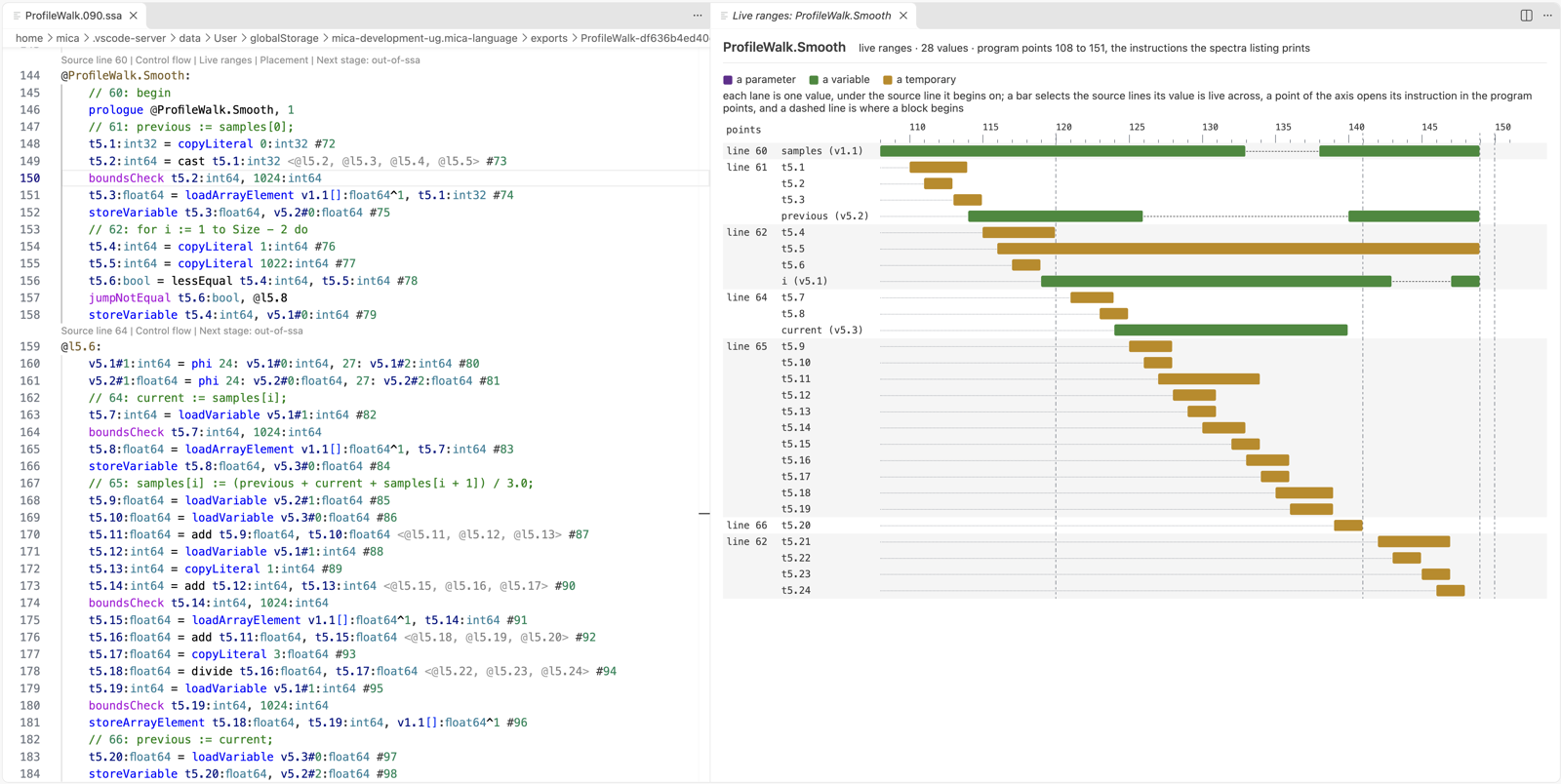
A bar’s hover names the value, its range and the instructions at its two ends; a click moves the editor to the source lines the value lives across, and a point of the axis opens its instruction in the program points, which open in a view of their own.
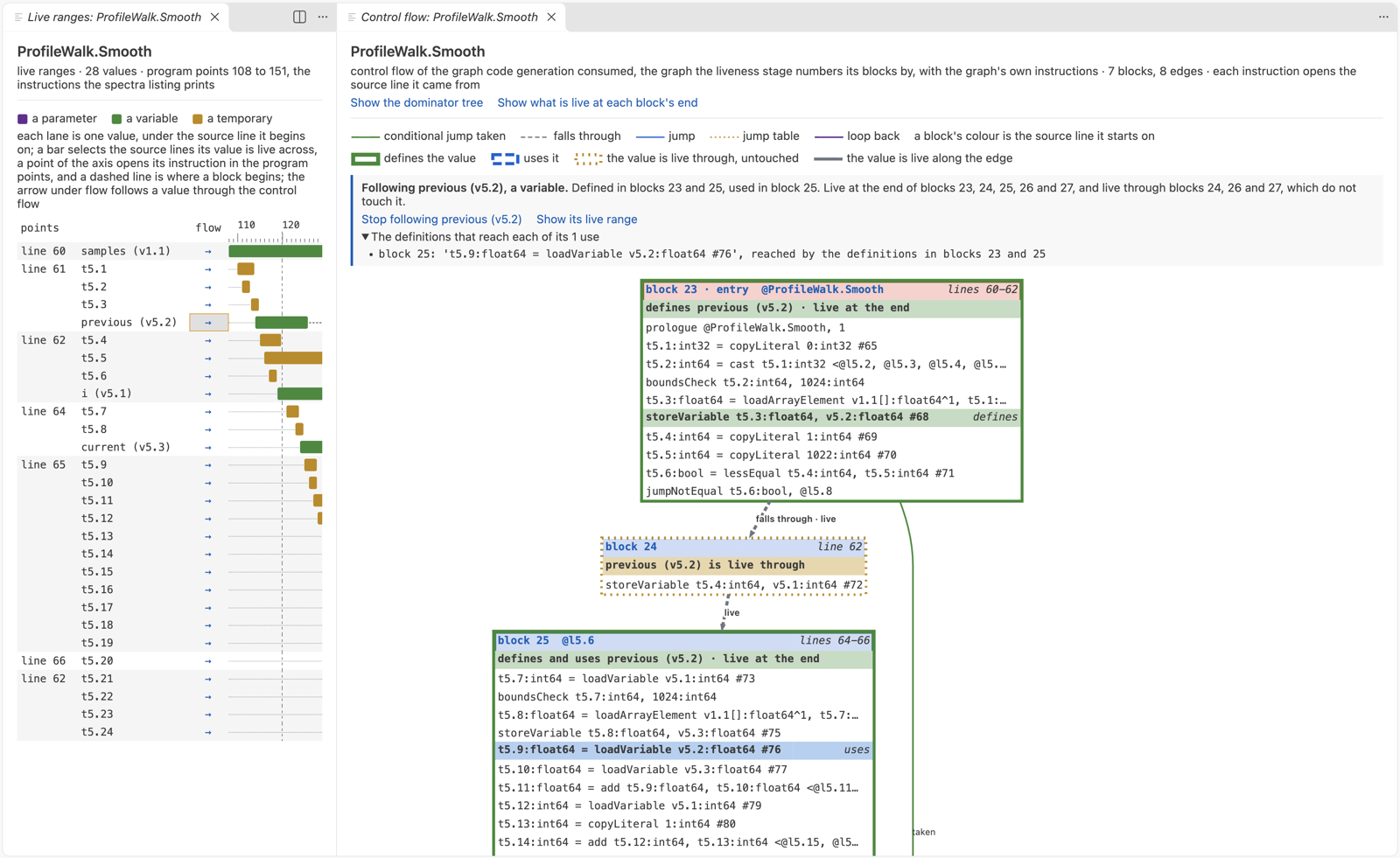
Follow Value in Control Flow marks one value in the routine’s
control-flow drawing. The arrow at the end of a lane, or a value named on a
line of any listing, chooses it. Here previous is followed: the block that
defines it and the block that defines and uses it stand in heavy outlines, the
block it is live through without touching it is dotted, and each edge it is
live along is drawn heavier with the word live. The header names the
definitions that reach each use.
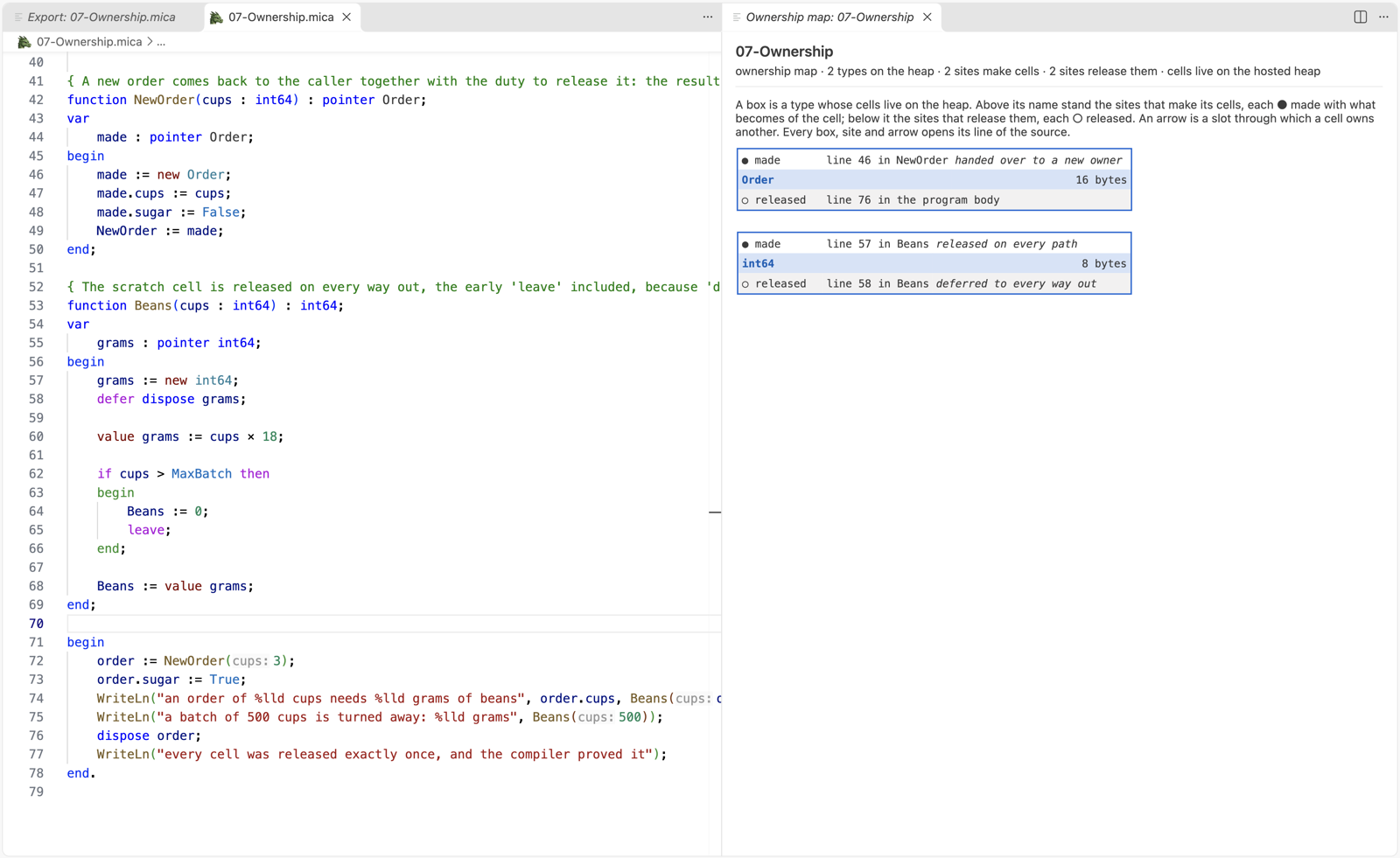
Show Ownership Map draws the shape of a unit’s heap as the compiler proved
it before the program runs: a box for each type whose cells live on the heap,
the sites that make its cells above its name, each with its line, its routine
and what becomes of the cell, and the sites that release them below. In the
picture, Order is made at line 46 and handed over to a new owner, and the
int64 made at line 57 is released on every path by the deferred release at
line 58.
An arrow from one box to another is a slot through which a cell owns another, so a tree’s node carries an arrow back to itself for its children. Every box, site and arrow opens its line of the source, and the export overview’s memory stage links to the map. All three drawings need the extension 5.9.0.
Fixed
- A narrow integer made from a 32-bit array element,
T[i] as int16, links at O2 on AArch64, where the assembler refused the reload the optimizer wrote through the element’s address with “invalid shift amount”. - An unsigned narrowing whose value is spilled at O2 on AArch64 and read straight back keeps its zero extension, where the bits above the narrow width survived and a comparison read them.
- An
O2,profilingbuild’s code is the release build’s to the byte again.
Upgrading
Things a 7.7.7 build meets differently in 7.7.8:
- A program that takes the address of a field or an element behind a nil
pointer stops there with
reason=nil_dereference (9)and the line and column of the statement, at every tier on both processors, where it ended by a segmentation fault once a routine wrote through the address. - A routine that only lends a place behind its pointer parameter pays for the nil test: a compare, a branch to a cold stub and, in a routine that kept no frame, a frame.
- No compile-time diagnostic is new or speaks differently.
- Dragon SDK: Spectra gains the operations
storeVariableWhenandstoreVariableUnless, which store a value into a variable where a boolean is set or clear and leave the variable as it is otherwise;capi/include/mica_dragon.hnames themDRG_OP_STORE_VARIABLE_WHENandDRG_OP_STORE_VARIABLE_UNLESS. They appear only in the unit leaving static single assignment at O1 and O2, Mica’s own generator writes neither, and the validator holds a frontend’s use of them to a temporary, a boolean and a whole variable or parameter of an integer, boolean or pointer type. The runtime floor contract stays at version 9.
The packages and the commands that install them are on the install page.